Domain, hosting and email: what each one is and who should own it
· 6 min read ·
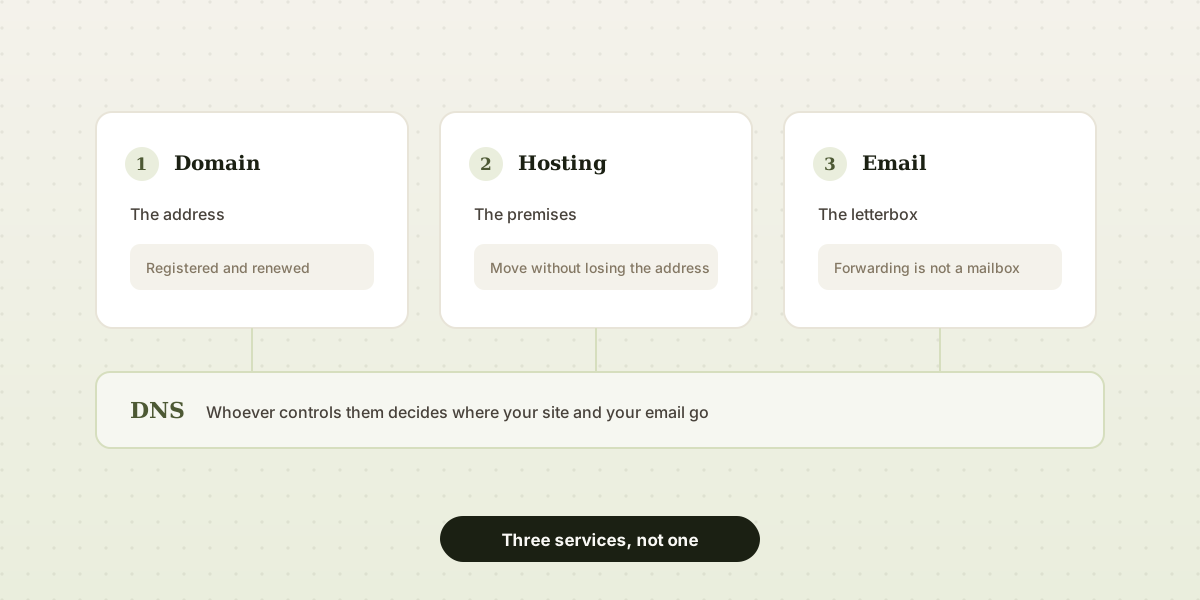
Almost every website quote carries a line reading "domain, hosting and email" as though it were a single thing. They are three separate services, they can be provided by three separate companies and they can be changed independently. Confusing them is why, two years later, nobody knows where anything is contracted or who to call when something breaks.
The comparison that works best is a shop:
- The domain is the address: "12 High Street".
- The hosting is the premises: the walls the business sits inside.
- The email is the letterbox on the door.
You can move premises and keep the address, and you can change address and keep the business. They are independent, and that independence is exactly what protects the client.
The domain: the address
The domain is the name typed into the browser. It is not bought outright: it is registered for periods of one to ten years and then renewed. Even after twenty years of use, it remains a reservation with an expiry date.
Two practical consequences follow. First, automatic renewal should be switched on with a valid payment method behind it; an expired domain takes down the website and the email at the same time, and recovering it once the grace period has passed can cost far more than renewing it. Second, the contact address on file for the domain should not be on that same domain: if it expires, the expiry warning arrives at a mailbox that has also stopped working.
The hosting: the premises
Hosting is the space on a server where the site's files live and from which they are served whenever somebody visits. What is being paid for is capacity and availability: storage, traffic handled, processing power and, with luck, backups.
Hosting can be changed without changing the domain. It is a house move: the site is copied to the new server and the domain is pointed at it. Visitors notice nothing. That this is so straightforward, when things are contracted properly, is the best argument for refusing arrangements in which everything depends on a single provider.
Professional email: the letterbox, sold separately
Owning the domain does not give you email, and the email included with hosting tends to cause trouble in practice: messages landing in junk folders and low sending limits.
Professional email is a mailbox service tied to the domain, with its own storage, its own spam filtering and proper access from a phone. It is what separates contact@yourcompany.com from a free account with the company name inside it. Beyond appearances there is an operational reason: mailboxes can be opened and closed as the team changes, and conversations do not leave with the person who leaves.
Two things that look alike are worth separating. A forward passes anything sent to that address on to another mailbox, but does not let you reply from it. A real mailbox does. If a quote says "email included", the question is which of the two.
What ties the three together: DNS
DNS is the directory that translates the domain name into a server address: it records which server serves the website and which service receives the email. It is the technical reason the three pieces can sit with three different providers and still behave as one.
You do not need to understand DNS to buy well, but you do need to know who has access to it: whoever controls the DNS controls where your website goes and where your email goes.
The domain is registered in your name, always
This is the rule with no exceptions. A domain record holds several contacts and only one of them decides: the registrant. Whoever appears there can transfer it, sell it, let it lapse or refuse to move it. The administrative and technical contacts manage it, but do not command it.
An agency or a freelance developer appearing as registrant is rarely bad faith: it was registered that way for convenience and nobody looked again. The outcome is the same either way. The day you want to change provider you will need their cooperation, and if the company closes or there is a disagreement over an invoice, the name your customers know you by sits in someone else's hands.
The correct arrangement is a domain registered to your company or to you personally, with your tax details and an email address of your own as the contact. Having someone else manage it is entirely reasonable; having someone else own it is not.
What to ask before signing
- Who is listed as the registrant? Ask to see the registered record, not a verbal assurance.
- Whose name are the accounts in, and who has access to the DNS?
- What is being paid, and how often? Domain, hosting and mailboxes have different prices and different cycles.
- Is the first year a promotional rate? Many offers rise sharply at first renewal. The figure that matters is the renewal price.
- Is the email a mailbox or a forward, and how much storage does each one get?
- What happens if the site moves to another provider tomorrow? The answer should be a list of steps, not an awkward pause.
What this costs per year
In Spain, VAT included, the reasonable orders of magnitude are:
- A .es or .com domain: between €12 and €25 a year.
- Hosting adequate for a business website: between €60 and €200 a year.
- Professional email: between €5 and €8 per mailbox per month.
That comes to somewhere between €150 and €350 a year for a small business with a couple of mailboxes. These are modest figures next to the cost of the website itself, which is exactly why it makes no sense to save here at the price of losing control of the address your customers find you at.
How the three pieces are split up here
It is worth saying where each one sits, because they do not all sit in the same place and the three get advertised together far too often.
Hosting is inside the fee, along with the certificate and the backups. It is not bought separately and it does not appear as a line item: a published site is a served site, and that is already paid for by the fee for its plan. The figures are on the pricing page.
The domain is bought by you, at whichever registrar you prefer, and it stays in your name, with your tax details and an email address of your own as the contact. None are sold here, and that gets said out loud: charging for paperwork somebody else does would be charging for nothing. What is provided, at no cost, is the exact guide to bring it over: the two records to create, written for your provider's own control panel. What does not change is who appears as registrant, which is you.
Email is not sold here, and saying so is more useful than offering it badly. It is a mailbox service provided by an email provider, bought in five minutes and pointed at from the domain's DNS. Somebody else running it is not a drawback: it is precisely the independence this article is about. The one condition is the usual one, that the account is in your name.
The website, which is the piece that goes inside those premises, is built here: you watch it finished as you type, and publishing it costs nothing.